Turns out, using MX stabilizers is quite tricky with buckling spring mechanisms: barrel top is 0.6mm above the top plate and all the dust and bread crumbs will go straight under the flipper.
So one either needs to severely redesign key travel limiter or add dust caps to the stems.
Added dust caps today. Not sure they warp when molded - I want to have a flat side so that LED can be added, and post-molding shrinking of the assymmetric part can be problematic.. Will think about travel limiter redesign.
horizontal plates are, from the top, MX cross base (5.6mm above plate), plate, PCB.
Modeling an F key mechanism
- DMA
- Location: Seattle, US
- Main keyboard: T420
- Main mouse: Trackpoint
- Favorite switch: beamspring
- DT Pro Member: NaN
- Contact:
- Attachments
-
- barrel-side-pressed.jpg (138.3 KiB) Viewed 77 times
- DMA
- Location: Seattle, US
- Main keyboard: T420
- Main mouse: Trackpoint
- Favorite switch: beamspring
- DT Pro Member: NaN
- Contact:
attached dust sleeves to barrels relatively easily. Supporting wall came about 0.75mm thick - should be enough for people not explicitly trying to break the key, I guess. Increasing barrel diameter should provide more sturdiness - but can cause barrel to keycap contact.
I guess I'm close to actually trying to find somebody who can do injection molding of these. Any ideas who can do it?
- DMA
- Location: Seattle, US
- Main keyboard: T420
- Main mouse: Trackpoint
- Favorite switch: beamspring
- DT Pro Member: NaN
- Contact:
Printed!
It's moderately scratchy and moderately wobbly (kinda comparable to MX switches I have, may be tad more. Comparable to model F, actually).
It doesn't bind.
It doesn't click either. I mean it clicks outside of the barrel. It clicks when key is all the way down and flipper disturbed. The spring resets when key gets back up. It just doesn't click when fully assembled. Key travel is 3.8mm - but actuation is somehow even lower.
PS: Noticed a weird thing: assembled model F actuates at around 2mm travel, and original parts assembled on the table at around 3. Turns out, it does matter how spring is mounted: mounting spring in a correct position (see Fig. 1) produces initial incline (see Fig. 2) of about 5 degrees, which - together with initial ~2.5mm of compression pre-bends the spring, setting the direction of future buckling, as well as dictating it's future direction.
Interestingly, Brother flavor of buckling spring is mounted strictly vertically. And they buckle at ~3mm! Except Brother pre-compresses their spring 1mm more (and key stem end actually stops ~0.5mm below the flipper's bottom!) - so I'm kinda lucky my "improperly mounted model F" buckes at 3mm.
Also, Brother springs are essentially model M - so it looks like that extra 15 grams of force are coming solely from that extra 1mm of spring compression!
Fig. 1: correct spring placement Fig. 2: initial angling of the spring
It doesn't bind.
It doesn't click either. I mean it clicks outside of the barrel. It clicks when key is all the way down and flipper disturbed. The spring resets when key gets back up. It just doesn't click when fully assembled. Key travel is 3.8mm - but actuation is somehow even lower.
PS: Noticed a weird thing: assembled model F actuates at around 2mm travel, and original parts assembled on the table at around 3. Turns out, it does matter how spring is mounted: mounting spring in a correct position (see Fig. 1) produces initial incline (see Fig. 2) of about 5 degrees, which - together with initial ~2.5mm of compression pre-bends the spring, setting the direction of future buckling, as well as dictating it's future direction.
Interestingly, Brother flavor of buckling spring is mounted strictly vertically. And they buckle at ~3mm! Except Brother pre-compresses their spring 1mm more (and key stem end actually stops ~0.5mm below the flipper's bottom!) - so I'm kinda lucky my "improperly mounted model F" buckes at 3mm.
Also, Brother springs are essentially model M - so it looks like that extra 15 grams of force are coming solely from that extra 1mm of spring compression!
Fig. 1: correct spring placement Fig. 2: initial angling of the spring
- DMA
- Location: Seattle, US
- Main keyboard: T420
- Main mouse: Trackpoint
- Favorite switch: beamspring
- DT Pro Member: NaN
- Contact:
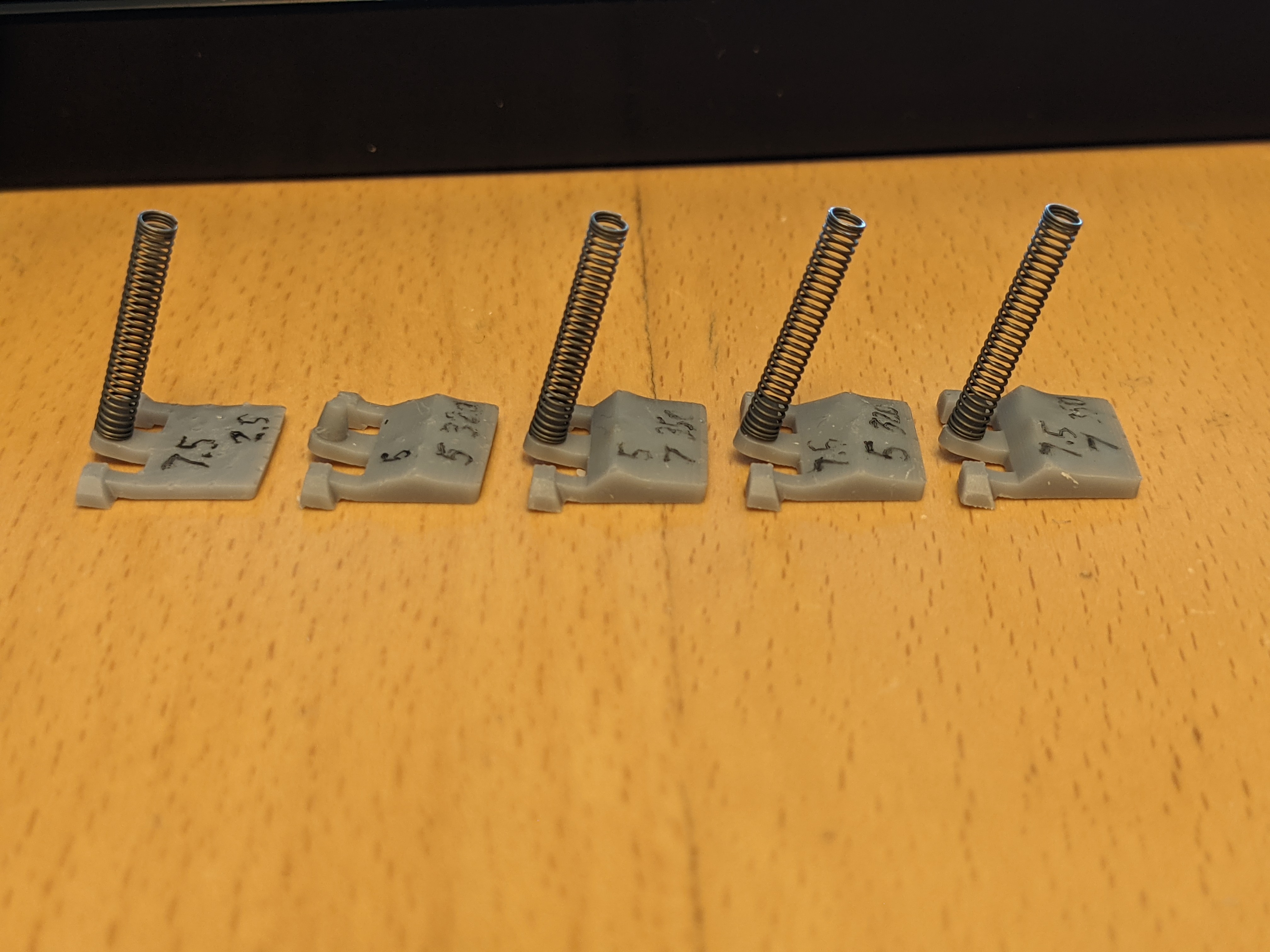
And so, I quickly designed some test flippers with varying degree of spring slant: 5 degree (varying spring support height), and 10 degree with default height.
Results: (flipper - actuation point)
5° - 3.5mm
5°+0.5mm - 2.75mm
5°+1mm - 2mm
5°+1.5mm - 1.5mm (fails to reset)
10° - 2mm
Somehow 5°+1mm feels crispier than 10°, and 5°+0.5mm even crispier - probably because the spring manages to store more energy before buckling, or there is such thing as too much pre-bending of the spring, so it buckles too readily - who knows!
Results: (flipper - actuation point)
5° - 3.5mm
5°+0.5mm - 2.75mm
5°+1mm - 2mm
5°+1.5mm - 1.5mm (fails to reset)
10° - 2mm
Somehow 5°+1mm feels crispier than 10°, and 5°+0.5mm even crispier - probably because the spring manages to store more energy before buckling, or there is such thing as too much pre-bending of the spring, so it buckles too readily - who knows!